
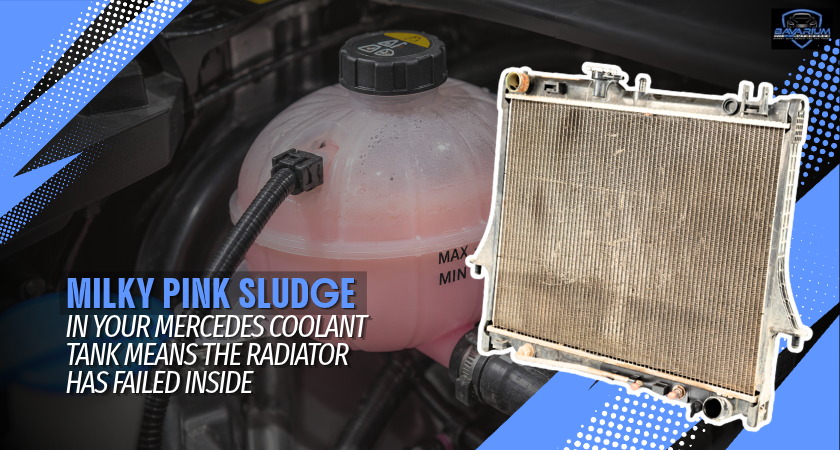
Open the hood expecting clear blue or clear pink coolant and find something that looks like a strawberry milkshake instead. Few things we see on a Mercedes are as urgent, and Mountain View owners who catch it early keep the repair to a radiator. The ones who drive on for another month usually do not. The cause is a crack inside the radiator itself, in a place you cannot see, between two fluids that are supposed to stay apart forever.
Quick Summary: Key Takeaways
- What you are looking at: transmission fluid and coolant mixed together inside the radiator and emulsified into a pink or tan sludge.
- Why it happens there: many Mercedes models run the transmission cooler inside the radiator’s end tank, separated only by a thin barrier.
- How fast it matters: coolant attacks the friction material inside an automatic transmission, and that damage is measured in days of driving.
- Stop driving it today: this is one of the rare faults where a tow costs less than the trip to the shop.
On most Mercedes models the radiator is also the transmission cooler
It is an efficient piece of packaging. Instead of hanging a separate cooler in front of the car, Mercedes routes transmission fluid through a sealed chamber built into one of the radiator’s end tanks, where the engine coolant flowing past carries its heat away. Two circuits, two fluids, one assembly, no extra plumbing.
The barrier between them is thin aluminum and plastic, and it spends its life being pushed on from both sides by fluids at different pressures and different temperatures. Years of that, plus the ordinary corrosion that comes with aging coolant, and the barrier eventually develops a pinhole.
The transmission circuit usually runs at the higher pressure, so fluid tends to push into the coolant first. So the coolant tank is where you see it first, and the transmission can feel completely normal on the day the symptom appears.
Coolant and transmission fluid do specific damage to each other
Automatic transmission fluid is a friction modifier as much as a lubricant. The clutch packs inside the gearbox depend on it behaving in a precise way, and the glycol in coolant ruins that behavior. It also swells the seals and attacks the adhesive that holds friction material to the clutch plates.
Going the other direction, transmission fluid in the cooling system coats the inside of the radiator and the heater core with a film that insulates them. The car starts running warmer, the cabin heat gets weaker, and the coolant loses its ability to do its job at exactly the moment it is needed most.
Neither process is slow enough to ignore. This is the one fault where we will tell you on the phone to leave the car where it is.
What to check before you call
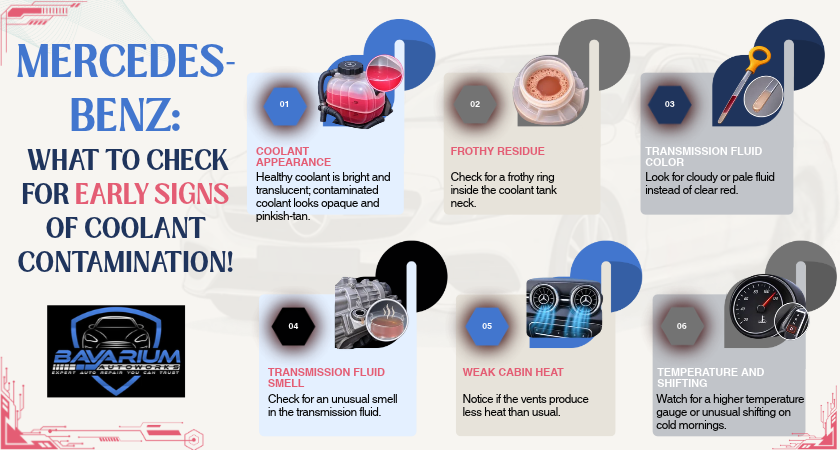
Look at the coolant tank first, with the engine cold. Healthy Mercedes coolant is translucent and brightly colored. Contaminated coolant is opaque, often pinkish-tan, sometimes with a frothy ring around the inside of the tank neck.
Then check the transmission side if your model has a dipstick. Fluid that has taken on coolant looks cloudy or pale instead of clear red, and it smells wrong. On models without a dipstick, that check belongs to us.
The symptoms that bring people in are usually indirect: weak heat from the vents, a temperature gauge sitting higher than it used to, or a transmission that has started shifting oddly on the first mile of a cool morning. Those arrive after the mixing has been going on for a while. Glance into the coolant tank every few weeks; it takes ten seconds.
The maintenance case for this is simple arithmetic. AAA’s 2026 Your Driving Costs study puts maintenance, repair and tires at 11.7 cents per mile across five years of ownership. A radiator fits comfortably inside that budget, and a transmission does not.
Replacing the radiator is the straightforward half
The new radiator goes in with new hoses, new O-rings and a fresh thermostat if the old one is anywhere near its service life, and the coolant goes back in under vacuum, because nothing else reliably keeps air out of the heater circuit. That half of the job is routine.
The part that decides whether the repair holds is the cleanup. Transmission fluid will have coated the heater core, the hoses, the thermostat housing and every passage in the block, and coolant will have made its way down the transmission cooler lines. Both circuits get flushed until they run clean, the cooler lines get replaced or thoroughly purged, and the transmission fluid and filter come out.
If the gearbox was caught early and still shifts correctly, a fluid and filter service is often the end of it. If it was not, the road test shows it, and the right move is to deal with the gearbox there and then. Handing the car back just moves the failure to March.
Frequently Asked Questions
Q: Can I drive my Mercedes with coolant in the transmission fluid?
A: We would not. Every mile circulates contaminated fluid through the clutch packs, and the damage is cumulative. Have it towed.
Q: Why is my coolant pink and milky instead of just low?
A: Pink and milky is an emulsion of coolant and transmission fluid. The two circuits have joined somewhere. Low coolant alone is an external leak and a different problem entirely.
Q: Will a radiator sealant product fix an internal radiator leak?
A: No, and it makes the repair worse. Sealant circulates through the heater core and the small coolant passages and blocks them, so you end up replacing more than you started with.
Q: How do I know whether the transmission was damaged?
A: By how it behaves once clean fluid is in it. A road test after the flush tells us whether the clutch packs are still engaging properly, and nothing short of that will answer it.
Leave the Car Where It Is
If the fluid in your coolant tank is not clear, bring the car to us before it gets driven further.
Bavarium Autoworks — 2232 Old Middlefield Way, Mountain View, CA 94043