

The Mountain View commute is a slow cooker. Crawl south on 101 past Shoreline, or sit in the afternoon backup on 85, and your Volvo stops getting the airflow it wants while the coolant temperature quietly climbs. On a mild spring day it recovers fine. On a 95-degree summer afternoon in bumper-to-bumper traffic, a marginal cooling system finally shows its hand.
A Volvo that runs warm in traffic is warning you long before it ever boils over. Catch it at the creeping-gauge stage, and the fix is simple. Ignore it until steam rolls out on the Central Expressway and you’re into head-gasket money, so a summer cooling check at our Old Middlefield Way shop is cheap insurance.
Quick Summary: Key Takeaways
- Traffic is the real test: Idling and low-speed crawling in heat is when a weak Volvo cooling system struggles most.
- Watch the gauge, not just the light: A needle drifting up in traffic and recovering on the freeway is an early warning.
- Volvos have known weak points: The electric cooling fan, water pump, thermostat, and coolant hoses all age and fail.
- Don’t drive it hot: A cheap hose or fan repair beats a warped head every time.
- A pressure test finds it: We locate the real cause instead of topping off coolant and hoping.
Stop-and-Go Heat Is Exactly When a Cooling System Fails
Cooling systems struggle most at low speed. On the open freeway, air rams through the radiator and helps carry the heat away, but in a 101 traffic jam near Shoreline that airflow vanishes and the car leans entirely on its electric cooling fan and water pump to keep temperatures under control.
That’s the summer problem in a nutshell. A Volvo with a weak fan or a tired water pump gets by while it’s rolling, then heats up the moment traffic locks up on a hot afternoon. Gauge climbing at idle, dropping once you move again? The cooling system is already asking for help.
What Overheating Looks Like Before the Warning Light
The dashboard light is the last warning, not the first. Long before it lights, you’ll notice the temperature gauge drifting above its normal center in slow traffic, the heater blowing warm when the A/C should be blowing cold, or a sweet coolant smell after you park, and sometimes a small puddle under the front of the car overnight.
Pay attention to those early signs. Caught here, a Volvo cooling repair stays manageable. Caught after the temperature buries itself in the red on 85, you’re usually looking at warped metal and a much larger bill instead. Big difference.

Why Volvo Cooling Parts Wear Out in Bay Area Summers
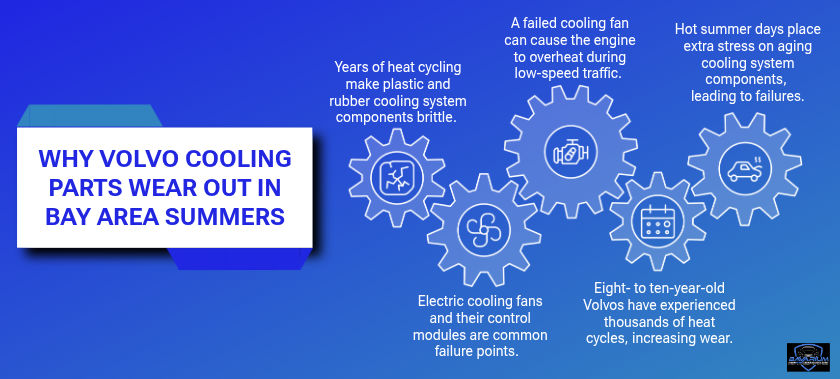
Plastic and rubber don’t love heat. Volvo cooling systems use plenty of both, and years of heat cycling make those parts brittle — the electric cooling fan and its control module are common failures, and when the fan won’t spin up in traffic, the car overheats only at low speed, which is the exact Mountain View pattern.
Age plus heat is the recipe. A Volvo that’s eight or ten years old has cycled its cooling parts thousands of times, and a run of hot summer days is what shoves the weakest one over the edge. Silicon Valley isn’t Phoenix. Even so, a packed 101 in July gets plenty hot under the hood.
Why You Don’t Limp an Overheating Volvo Home
Heat wrecks engines, not miles. When coolant temperature spikes, the aluminum cylinder head warps and the head gasket fails, and that can happen in the span of a single hot traffic jam, so a failed fan or a leaking hose — real money on its own — still counts as minor next to a warped head and a gasket job.
So don’t push it. If the gauge climbs into the red or you see steam, get off the road, shut it down, and call a tow. AAA expected to rescue 7.7 million drivers over summer 2025, and overheating is one of the top reasons a commute ends on a tow hook.
How We Run a Cooling Check on Your Volvo
We don’t just top off the coolant and wave you on. Our techs pressure-test the system, verify the electric cooling fan actually spins up when it should, check the water pump and thermostat, and inspect the radiator and hoses for leaks and soft spots — and factory-grade diagnostics tell us whether you’re losing coolant outside or past a gasket.
Then we fix what failed. We refill with the correct Volvo coolant, bled properly so no trapped air pocket creates a hot spot later on, and Mountain View, Palo Alto, Cupertino, and Sunnyvale drivers rely on us to catch these problems before they ever turn into full engine jobs.
Why Silicon Valley Volvo Owners Choose Bavarium Autoworks
We know Volvos cold. We’re a European specialist on Old Middlefield Way with close to three decades under the hood; we use the right diagnostic tools, we explain what we find in plain language, and we won’t sell you a repair the car doesn’t actually need to get through the summer.
Straight answers. Correct parts. If your Volvo is running warm on the commute, bring it in for a cooling check before the next heat wave finds the weak part for you.
Frequently Asked Questions
Q: Why does my Volvo overheat in traffic but not on the highway?
A: It’s an airflow problem. At highway speed, air rams through the radiator and sheds heat, but in stop-and-go traffic that airflow disappears and the car depends entirely on its electric cooling fan and water pump — so if either is weak, the Volvo runs fine while moving and heats up the moment traffic stops.
Q: What are the early signs my Volvo’s cooling system is failing?
A: Watch for the gauge drifting above center in slow traffic, the heater blowing warm, a sweet coolant smell after parking, or a small puddle under the front of the car, because these show up well before the dashboard warning light, and catching them early keeps a modest repair from turning into an engine job.
Q: Is it safe to keep driving a Volvo that’s running hot?
A: No. If the gauge climbs into the red or you see steam, pull over, shut the engine off, and have it towed, because continuing to drive an overheating Volvo can warp the cylinder head and blow the head gasket, turning a fan or hose repair into a much more expensive fix.
Q: How much does a Volvo cooling system repair cost?
A: It depends on the failed part. A thermostat, hose, or cooling fan is a moderate repair, while a water pump or radiator costs more, and if overheating has already damaged the head gasket, the bill climbs sharply — which is exactly why an early cooling check pays for itself.
Book a Summer Cooling Check for Your Volvo in Mountain View
Gauge creeping up in traffic? Bring your Volvo in for a cooling check before it boils over on 101.
Bavarium Autoworks — 2232 Old Middlefield Way, Mountain View, CA 94043
Hours: Mon–Fri 7:30 AM – 5:00 PM; Sat–Sun closed
Website: bavariumautoworks.com