
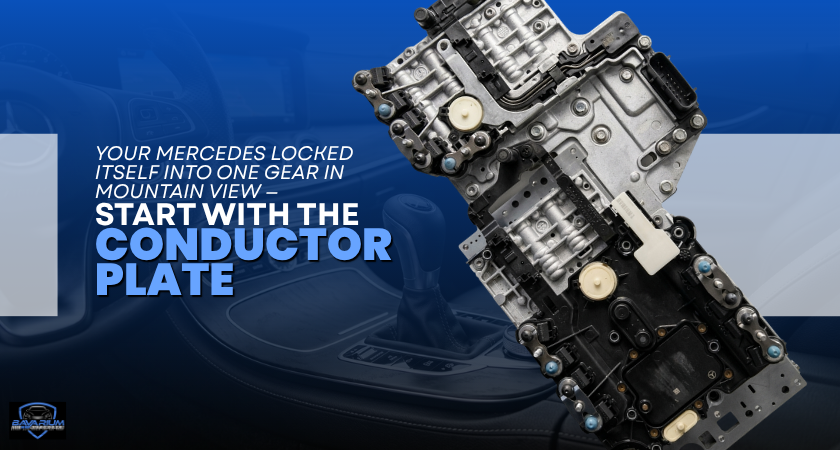
Cold morning on Old Middlefield Way. You back out, the car pulls away in one long lazy gear, and a transmission warning glows the whole way down Shoreline Boulevard. That is limp mode, and on a Mercedes running the 722.9 seven-speed the part behind it is almost always the conductor plate — the electronic brain that lives inside the transmission, not bolted to the outside of it.
October mornings here sit in the forties before the sun clears the hills, and cold is when this fault introduces itself. Drivers come to us from Palo Alto, Cupertino and San Jose with the same story: fine at 3 p.m., stuck in second at 7 a.m. It will not fix itself, and every mile driven in limp mode loads one gear set with everything the engine makes.
Quick Summary: Key Takeaways
- What limp mode really is: A 722.9 that holds a single gear and lights the dash has usually lost a shaft speed signal from its conductor plate.
- Cold comes first: The fault typically appears on the first cold start of the day, clears once fluid warms, then stops clearing altogether.
- The 13-pin leak: Transmission fluid wicks out of the connector on the side of the case, travels up the harness and ruins the plug or the control unit.
- It usually stays inside the pan: most cars need a conductor plate, a connector adapter and fresh fluid, and the gearbox never leaves the car.
- Read the codes first: Have the transmission fault memory pulled before anyone disconnects a battery, because clearing codes throws away the evidence.
A failing conductor plate is why the car holds one gear
The conductor plate carries the transmission’s internal wiring, its two shaft speed sensors and the feed to every shift solenoid, all molded into one plastic assembly under the valve body. Lose one speed signal and the control unit no longer knows what the input and output shafts are doing, so it stops guessing and freezes a single ratio — usually second. That is a protection strategy, not a failure of the gears themselves. Blame the sensor, not the clutch packs.
We see it most on 2004–2012 E350, C300, ML350 and GL500 models, and the pattern barely varies between them: a stored speed sensor code, a car that drives like a tractor, and a gearbox that is mechanically fine underneath.
The symptoms arrive cold and get bolder every week
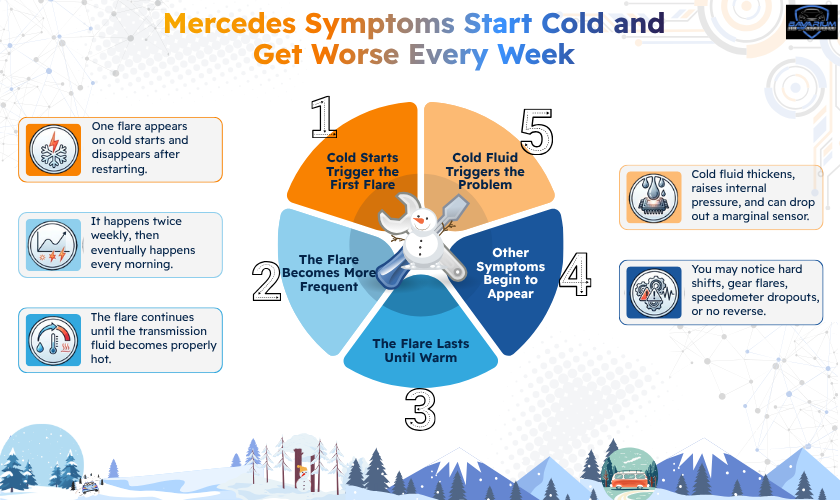
Early on it is a single flare on a cold start that vanishes after a restart. Then it happens twice a week. Then it happens every morning and stays until the fluid is properly hot, and finally it never leaves at all. Along the way you may notice a hard 1–2 shift, a flare between gears, a speedometer that drops out, or a car that refuses reverse in a parking garage.
Cold fluid is the trigger, not a coincidence. The U.S. Department of Energy’s fuel economy testing, updated with model-year 2019 vehicles, found city fuel economy runs roughly 15% lower at 20°F than at 77°F partly because transmission and driveline fluids thicken when they are cold — thicker fluid means higher internal pressures and a marginal sensor that finally drops out.
Heat, mileage and a leaking connector finish the plate off
Three things kill conductor plates. Heat cycling makes the plastic brittle and the solder joints tired. Mileage wears the speed sensors, which are simply not built to last 200,000 miles. And the 13-pin connector on the driver’s side of the case leaks fluid into its own wiring, sending automatic transmission fluid up the harness toward the control module — a slow, quiet failure that turns a small adapter job into a much larger repair.
Traffic finishes the job. Crawling on the 101 keeps fluid temperatures high, and a gearbox still on its original fill is running oil that gave up years ago.
Driving on it turns a sensor job into a gearbox job
Limp mode is survivable for a trip home. It is not survivable as a habit. Second gear takes every bit of engine torque from a standstill, the converter slips more than it should, and fluid temperature climbs — which is exactly how clutch pack material ends up circulating through the valve body.
The other risk is electrical. Fluid that reaches the transmission control module can take the module with it, and that is a much larger bill than the plate ever was. Fix the plate early and the job stays inside the pan.
How the fault gets pinned down before a single part is ordered
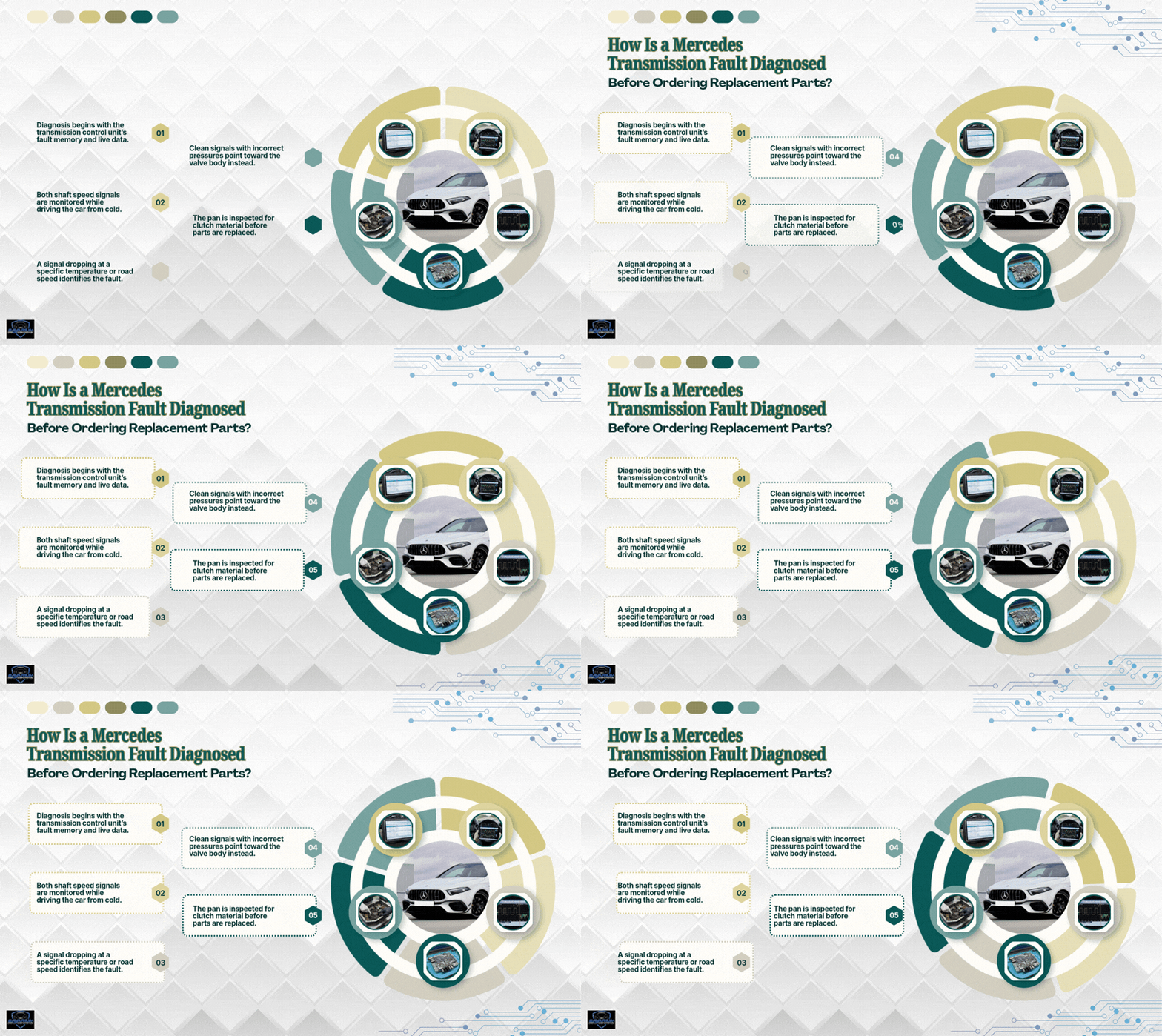
Diagnosis starts with the transmission control unit’s own fault memory and live data, watching both shaft speed signals while the car is driven from cold. If one signal drops at a specific temperature or road speed, that is the answer. If both signals look clean and the pressures are wrong, the valve body is the suspect instead, and the repair changes completely.
Then the pan comes off. The plate, the connector and the fluid all get inspected for clutch material, the plate and adapter are replaced with proper parts, the fill is done by temperature rather than by eye, and the adaptation values are reset so the car relearns its shifts.
Frequently Asked Questions
Q: What are the symptoms of a bad conductor plate on a Mercedes?
A: Limp mode in a single gear, a stored speed sensor fault, a speedometer or gear display that drops out, harsh or flaring shifts, and sometimes no reverse. Cold starts usually show it first, and a fluid-soaked 13-pin connector on the side of the transmission is the giveaway.
Q: Can you drive a Mercedes in limp mode?
A: Short distances at low speed, yes — that is what the strategy is for. Living with it is a bad trade, because one gear set absorbs all the load and fluid temperatures stay high, which is how a sensor problem grows into a clutch pack problem.
Q: Does the transmission have to come out of the car for this?
A: No. The plate, the connector adapter, the filter and fresh fluid all sit inside the pan, and the gearbox stays where it is. What changes that picture is fluid full of friction material, or a valve body already damaged by months of driving on a bad signal.
Q: How often should Mercedes 7G-Tronic transmission fluid be changed?
A: Sooner than the lifetime fill label implies. Automatic transmission fluid shears down and its friction modifiers wear out long before 100,000 miles, and clean fluid is the cheapest protection a 722.9 gets. Bring the car’s history with you and ask.
Bring the limp-mode Mercedes in before it teaches itself bad habits
One cold-start flare is a warning. Two is a schedule. Bring the car to our Old Middlefield Way shop, and you will get the stored codes read, the connector inspected and a straight answer about whether this is a plate or something deeper.
Bavarium Autoworks — 2232 Old Middlefield Way, Mountain View, CA 94043
Hours: Monday to Friday, 7:30 AM to 5:00 PM. Closed Saturday and Sunday.
Website: bavariumautoworks.com