
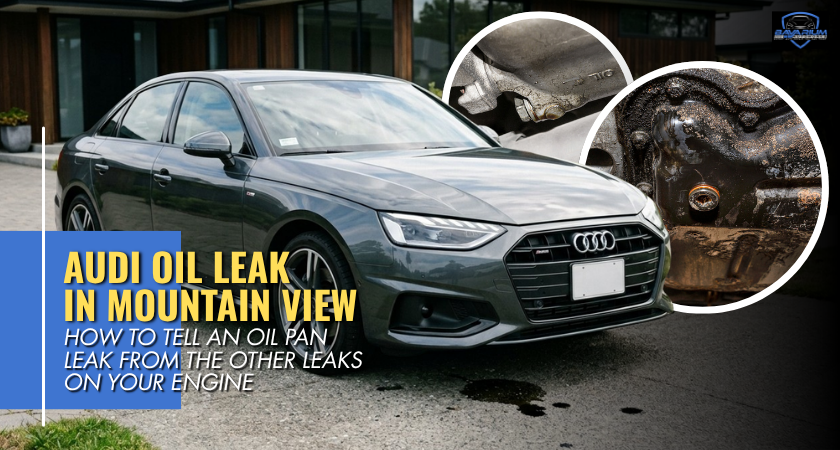
Most drivers who find an Audi oil leak blame the oil pan, because that’s where the drop falls. Often it isn’t the pan. Oil runs downhill, so a seep from a valve cover or a cam tensioner seal can travel down the engine, gather on the pan and drip from its lowest edge. In Mountain View, the first real rains of the season spread even a small drip into a rainbow sheen on the driveway. Sort out the source before a holiday run down 101 or over 280.
Quick Summary: Key Takeaways
- The drip point isn’t always the source: oil from higher up often runs down and falls off the pan.
- Pan and plug leaks leave their own marks: a tired pan gasket wets the seam, while a drain plug problem stays at one spot.
- Low oil is the real danger: driving on a leak can damage the engine once the level drops too low.
- Rain carries the drip away: Cupertino asks drivers to set a drip pan under a leaking car until it’s fixed.
An Audi Oil Leak Rarely Drips From the Spot Where It Starts
The drip point is only a clue. The wet, grimy part of the engine, wherever it sits on the block, is what shows you where the oil is actually escaping. A pan leak keeps the oil low, while a leak from above leaves a dark, dusty film down the side of the block that ends at the pan, so follow the wet trail upward.
Bavarium‘s oil-leak page lists the usual suspects: seals, the pan, engine gaskets, bad connections, the drain plug, the timing cover seal and the valve cover gasket. Two can leak together. And a pan coated in old oil from a valve cover that leaked last winter can look guilty even when its own gasket is fine. That’s why the job starts with finding the one that’s actually losing oil.
Signs It Really Is the Oil Pan Gasket or the Drain Plug
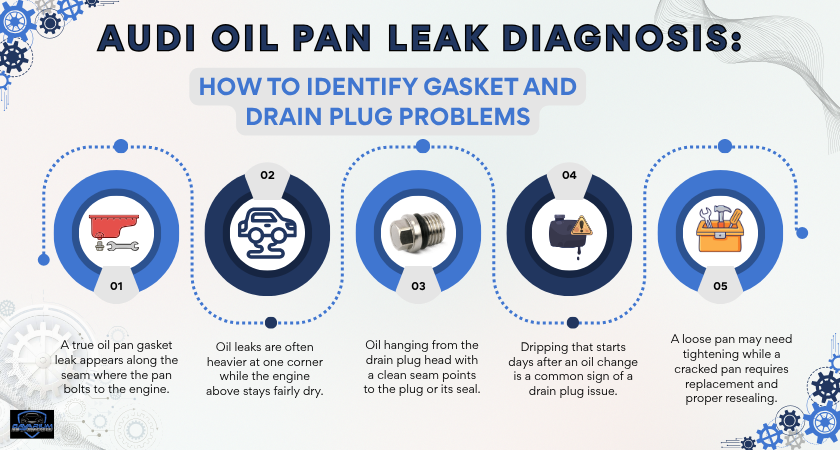
A true pan leak shows up along the seam where the pan bolts to the engine. It’s often heavier at one corner. The engine above stays fairly dry, and the cause is usually the seal along that line, a pan left loose after earlier work, or one cracked by a scrape over a steep driveway lip or a parking-garage ramp.
The drain plug looks different. Oil hanging from the plug head, with a clean seam around it, points to the plug or its seal, and a drip that starts days after an oil change is the classic case. A loose pan sometimes only needs tightening. A cracked one means Audi oil pan replacement, and a proper reseal depends on clean, flat mating surfaces on both the pan and the engine before any new gasket or sealant goes on.
Valve Cover and Tensioner Seals That Fake a Pan Leak
Two leaks higher up are the usual impostors. A hardened valve cover gasket lets oil out at the top of the engine, and the bit that lands on hot exhaust parts is where the burning smell after a drive comes from. The rest runs down. It drips off the pan.
Cam tensioner and timing cover seals do the same from the side or front. Neither is rare. If the top of the engine is wet, a new pan gasket won’t stop anything. Bavarium has covered valve cover oil leaks on Audis in more depth, including the misfire that can follow.
What Proper Audi Oil Leak Repair Looks Like
Good Audi oil leak repair proves the source first. The shop describes it plainly: go into the engine, check each component to find the one leaking, fix it, then run diagnostics to confirm the repair. A grimy block hides which seal is fresh. Cleaning it, running the engine and watching which surface turns wet again is what separates a leak that’s active today from one that dried up years ago.
Guessing gets expensive. Reseal the pan on a car whose real problem is the valve cover, and you’ve paid for a job that leaves the drip exactly where it was. Bavarium’s ASE certified mechanics work on Audis with factory-grade tools and equipment.
A Drip in the Rainy Season Doesn’t Stay on Your Driveway
Rain moves that oil. Cupertino’s stormwater program explains that storms carry oil and other auto fluids off driveways and streets into storm drains that flow straight to local creeks and San Francisco Bay. Its advice for a leaking car is a plastic tarp or drip pan underneath until the repair is done.
It takes very little oil. The EPA’s used-oil guidance, updated in June 2026, warns that a single oil change’s worth of used oil is enough to foul a million gallons of fresh water. Cupertino also wants the soaked tarp or drip pan taken to a household hazardous waste collection center rather than the trash.
Frequently Asked Questions
Q: How do I know if my Audi oil pan is leaking?
A: Check the seam where the pan meets the engine. Fresh oil along that line, with a dry engine above it, points to the pan gasket. Oil hanging only from the drain plug points to the plug or its seal.
Q: Why is my Audi leaking oil after an oil change?
A: Suspect the drain plug first, especially if the drip starts within days of the service. It leaks from one spot. The fix is usually quick.
Q: Can a valve cover leak drip from the oil pan?
A: Yes. Oil escaping at the top of the engine runs down the block and often falls from the pan’s lowest edge, so check the valve cover gasket before paying for a pan reseal.
Trace the Audi Oil Leak Before the Holiday Miles
Slide a flattened cardboard box under the engine tonight. In the morning, photograph it beside the front tire, so the drip’s position is on record before anything gets cleaned. Your Audi heads to 2232 Old Middlefield Way, Mountain View, CA 94043, with the photo on your phone. Any burning smell belongs in the comments box of the request form on bavariumautoworks.com.