Oil on the pavement, a faint burning smell from the engine bay, or a thin streak of grime trailing down the back of your engine — these are the first signs most Mountain View Volkswagen owners notice before they know they have a camshaft seal problem. The camshaft seal is one of those components that doesn’t fail loudly or immediately. It goes slowly, and because the leak is often minor at first, it’s easy to dismiss. By the time the oil loss becomes obvious, the seal has usually been deteriorating for some time. Bavarium Autoworks on Old Middlefield Way has been handling Volkswagen repairs in Mountain View for over 28 years, and camshaft seal replacement is a job their ASE-certified technicians have done hundreds of times across the full range of VW models.
What the Camshaft Seal Does and Why It Fails
The camshaft is located at the top of the engine and is responsible for opening and closing the intake and exhaust valves with precise timing. At each end of the camshaft sits a seal — typically a rubber or PTFE lip seal pressed into the engine housing — that prevents oil from escaping past the shaft as it rotates. These seals are designed to last, but heat cycling, age, and the chemistry of modern engine oil eventually cause the rubber to harden, shrink, or crack. Once the seal loses its ability to maintain compression against the camshaft, oil begins migrating outward. On Volkswagen’s TSI and TDI engines in particular, the front camshaft seal is a known wear item. The combination of high operating temperatures in a compact engine bay and the turbocharger’s contribution to sustained heat exposure accelerates seal degradation faster than it might on a naturally aspirated engine.
Why This Repair Requires a Specialist
Replacing a camshaft seal sounds straightforward on paper — remove the old seal, press in a new one — but the surrounding work is what makes it a specialist’s job. Accessing the front camshaft seal on a Volkswagen typically requires removing the timing belt cover or timing chain cover, and in many cases involves working around or near the timing components themselves. This is not a repair where corner-cutting is acceptable. If the timing marks aren’t preserved correctly, if the tensioner isn’t handled properly, or if the new seal isn’t seated at exactly the right depth and orientation, the consequences range from an immediate re-leak to — in the worst case — a timing event that damages valves or pistons. Bavarium Autoworks uses factory-grade diagnostic and timing tools specific to Volkswagen, which allows their technicians to approach the job with the precision the platform requires. OEM-certified parts are used on every VW repair, which is particularly important for seals and gaskets where specification tolerances directly affect seal life.
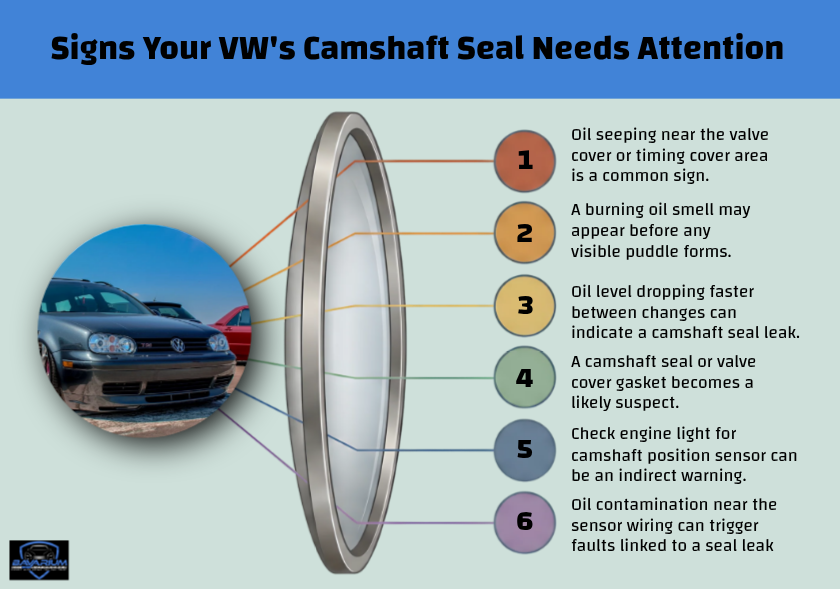
Signs Your VW’s Camshaft Seal Needs Attention
The most common indicator is oil seeping from the front of the engine near the valve cover or timing cover area. Because the engine bay is hot and enclosed, small amounts of escaping oil can burn off before they accumulate visibly, which is why a smell rather than a puddle is often the first clue. If you notice your VW’s oil level dropping faster than usual between changes without an obvious external leak on the ground, a camshaft seal or valve cover gasket is high on the list of suspects. A check engine light pointing at a camshaft position sensor is another indirect signal — oil contamination around the sensor or its wiring can trigger sensor faults that look like an electrical issue but are rooted in a seal leak. Bavarium Autoworks’ diagnostic process covers the full scope, so the root cause is confirmed before anything is replaced.
What Preventive Attention Looks Like
The best time to address a camshaft seal is during a timing belt service interval, when the timing cover is already removed, and access to the seal is part of the job. On VW models that still use a timing belt, Bavarium Autoworks recommends addressing the camshaft and crankshaft seals at the same time as the belt replacement — the incremental cost is minor compared to coming back in for a separate job with the same teardown. For chain-driven VW models, the same logic applies when any work takes the technician into that area of the engine.
Bavarium Autoworks serves Mountain View, Cupertino, Palo Alto, San Jose, Santa Clara, and Saratoga.
📍 2232 Old Middlefield Way, Mountain View, CA 94043 📞 (650) 962-9401 🌐 bavariumautoworks.com
FAQ
How do I know if my Volkswagen’s camshaft seal is leaking?
Oil residue near the front of the engine, a burning oil smell, faster-than-normal oil consumption, or camshaft position sensor fault codes are all signs. A visual inspection by a VW specialist confirms the leak source.
Is camshaft seal replacement a major repair on a Volkswagen?
It’s a moderate repair that requires careful handling of timing components. It’s not major in terms of parts cost, but it demands precision and the right equipment, which is why a VW specialist is the right choice.
Can a leaking camshaft seal cause engine damage if left alone?
Over time, yes. Oil loss accelerates wear across the engine, and oil contaminating belts, pulleys, or sensors causes secondary damage. Addressing the seal when the leak is minor avoids larger repairs.
Should I replace the camshaft seal when I replace my VW’s timing belt?
Yes — proactively replacing camshaft and crankshaft seals during a timing belt service is standard practice. The extra cost is minimal when the area is already disassembled.