
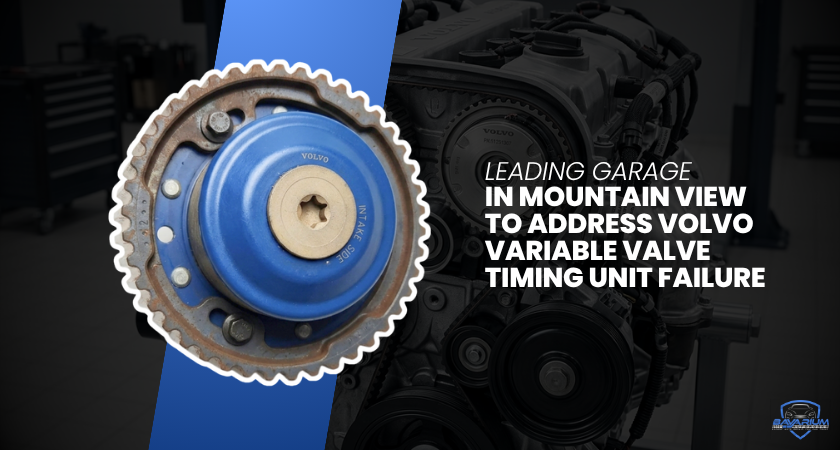
Volvo’s variable valve timing system is central to how modern Volvo engines balance power, efficiency, and emissions. When the VVT unit starts to fail, Mountain View Volvo owners quickly notice it — a rough idle, sluggish acceleration, oil consumption that doesn’t add up, and a check engine light that keeps coming back, no matter what the last shop tried. These aren’t random symptoms. They’re a predictable pattern that points to one of the most common failure points in the Volvo inline-five and inline-six engine families.
Bavarium Autoworks is Mountain View’s European auto repair specialist, serving Volvo owners across Mountain View, Palo Alto, Cupertino, Santa Clara, and Saratoga from our Old Middlefield Way location. If your Volvo is showing these symptoms on the 101, El Camino Real, or anywhere in the Silicon Valley corridor, here’s what you need to know.
What the Volvo Variable Valve Timing Unit Does
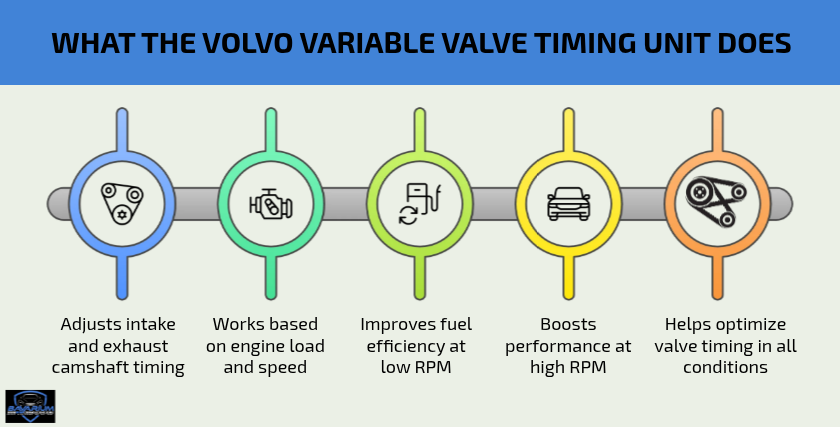
The variable valve timing unit — commonly called the VVT solenoid or cam phaser — adjusts the timing of the intake and exhaust camshafts relative to the crankshaft based on engine load and speed. At low RPM, it optimizes for fuel efficiency. At high RPM it opens up for performance. When it functions correctly, you never think about it. When it fails, the engine can’t optimize valve timing under any condition, and the symptoms appear across the entire RPM range.
On Volvo’s B5254 and B6294 engines — found in the S60, V70, XC70, S80, and XC90 — VVT unit failure is a well-documented failure pattern, typically driven by oil sludge buildup in the oil passages that feed the solenoid, or physical wear in the unit itself.
Symptoms of Volvo VVT Unit Failure Mountain View Drivers Notice
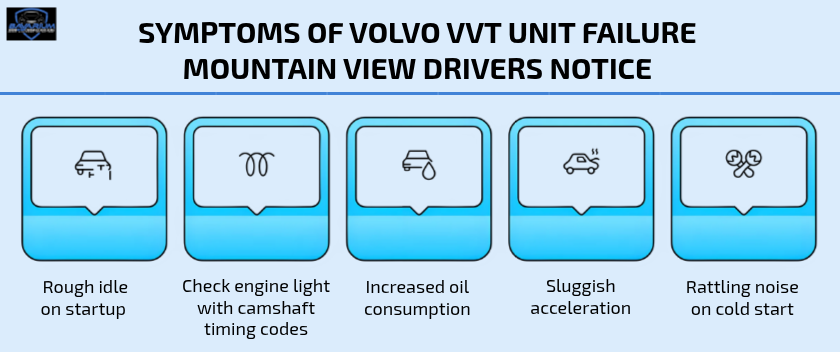
- Rough idle on startup — the engine stumbles and hunts for a stable RPM when cold, then smooths out as oil pressure builds. This is the classic early warning sign.
- Check engine light with camshaft timing codes — fault codes P0011, P0012, P0014, or P0016 pointing to camshaft position over-advance or under-advance. These are frequently misdiagnosed as cam sensors when the VVT unit is the actual cause.
- Increased oil consumption — a failing VVT solenoid can allow oil to bypass into areas of the engine where it shouldn’t be, accelerating consumption without a visible external leak.
- Sluggish acceleration — incorrect valve timing robs the engine of power across the RPM range, producing a flat, unresponsive feel that’s particularly noticeable merging onto the 101 or 85.
- Rattling noise on cold start — oil starvation in the VVT mechanism produces a brief metallic rattle on startup that clears as oil pressure builds. Don’t ignore this — it means the unit isn’t getting oil fast enough.
Why Mountain View Volvo Owners Shouldn’t Delay
VVT failure is a progressive condition. The sludge or wear that’s causing the initial symptoms continues to worsen with every cold start. Left unaddressed, what starts as a rough idle becomes permanent camshaft timing deviation, accelerating wear on the camshaft itself and the bearings that support it. A VVT unit replacement that costs a few hundred dollars today can prevent a camshaft replacement that costs several times more.
Silicon Valley’s stop-and-go commute traffic — the kind Mountain View and Palo Alto drivers deal with daily on 101 and 85 — is particularly hard on VVT systems because it produces frequent cold starts and oil pressure cycling that accelerates wear on already-compromised units.
How Bavarium Autoworks Diagnoses and Fixes Volvo VVT Failure
Bavarium Autoworks uses Volvo-compatible diagnostic equipment to read live camshaft timing data and confirm VVT unit failure before any parts are ordered. This step matters because camshaft position codes can have multiple causes, and replacing the VVT unit when the actual fault is an oil passage blockage or a cam sensor produces a repeat visit instead of a fix.
Once the fault is confirmed, we replace the VVT unit and perform an oil system flush if sludge buildup contributed to the failure — because installing a new unit into a sludged oil system shortens its life significantly. Every repair is verified with a post-repair scan before the vehicle leaves our shop.
For Volvo repair and service in Mountain View backed by genuine platform expertise, and check engine light diagnosis that finds the actual cause rather than the surface symptom, Bavarium Autoworks is the shop Mountain View Volvo owners rely on. We also offer oil change service using correct Volvo-specification fluids — the single most important preventive measure for VVT longevity.
Frequently Asked Questions About Volvo VVT Failure in Mountain View
How much does a Volvo VVT unit replacement cost in Mountain View?
Cost depends on the specific model and whether oil system cleaning is required. Bavarium Autoworks provides a complete diagnosis and estimate before any work begins. Call (650) 962-9401 for a consultation.
Can I drive my Volvo with a failing VVT unit?
Short distances are possible, but every cold start with a failing VVT unit accelerates wear on the camshaft and surrounding components. Address it promptly.
Which Volvo models are most affected?
The S60, V70, XC70, S80, and XC90 with B5254 and B6294 engines are the most commonly affected. If your Volvo is in this range and showing the symptoms above, have it inspected.
Schedule Your Volvo VVT Diagnosis in Mountain View Today
Bavarium Autoworks is at 2232 Old Middlefield Way, Mountain View, CA 94043. Call (650) 962-9401 or stop by Monday through Friday, 7:30am to 5:00pm.